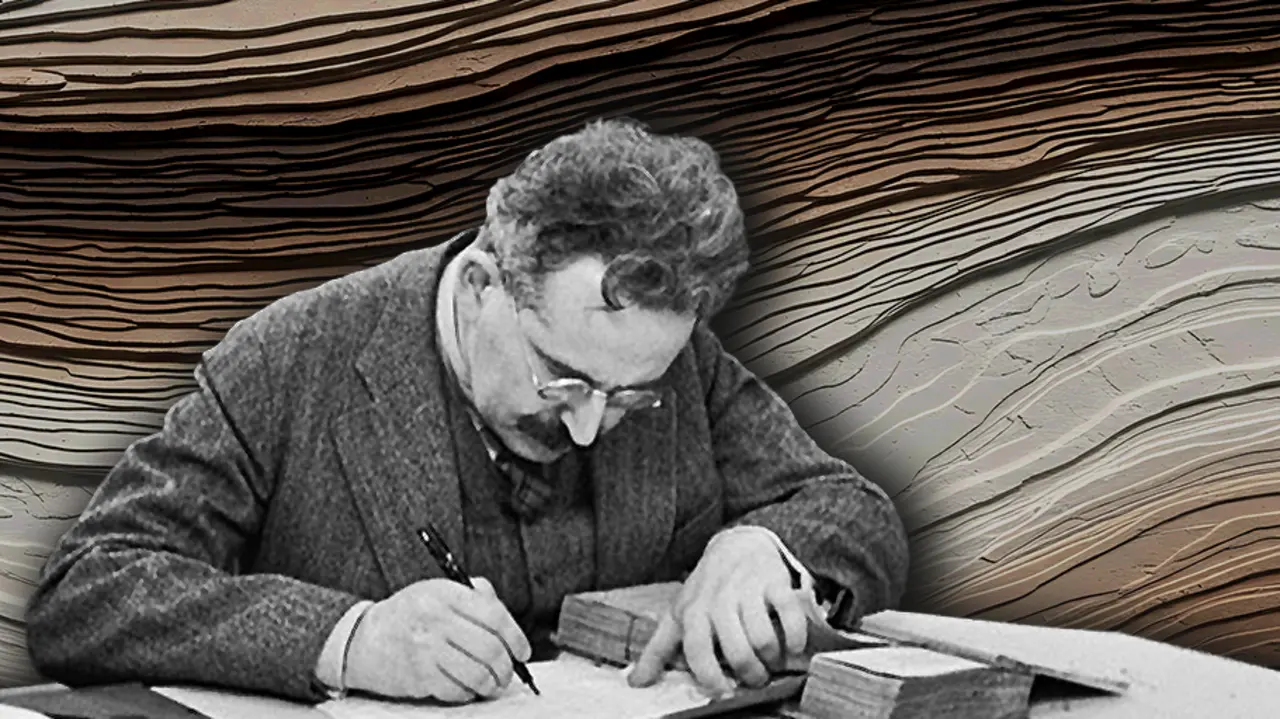
The flow of time is ours to disrupt
<p><em>We tend to experience time as a river flowing inexorably forward: linear, orderly, with the past firmly in the past. But <strong>Timotheus Vermeulen</strong>, the cultural theorist who first popularized the idea that our era is “metamodern,” argues that such metaphors are misleading. Drawing on imagery from the philosopher Walter Benjamin, he proposes that temporal experience is closer to clay on a potter’s wheel, something we can grip, turn and remould. In poetry, film, memes and music, we play with time, using anticipation, gesture, rhythm and repetition to fracture its linear flow. Time is not simply a background condition of our experience—we can use it to sculpt and remake consciousness itself.</em></p><p> </p><p>Sometime between 1914 and 1915, the German philosopher and cultural critic Walter Benjamin wrote an essay on two poems by the Romantic poet and misunderstood visionary Friedrich Hölderlin. It is a peculiar and little-known piece of writing. By the author’s own account, it should be a straightforward exercise in close reading. But by the time he draws his conclusions he has offered all of a circuitous metaphysics of poetry, an implicit contemplation of the nature of time, and an elegy for his childhood friend Fritz Heinle, a would-be poet who had killed himself earlier that year. It’s also unmistakably the work of a young writer still finding his voice: grandiose, purple, convoluted, banal, exciting, inconclusive, all impulse and little orientation.</p><p>Benjamin is celebrated today as one of the great stylists among theorists (especially compared to some of the others associated with the Frankfurt School), a master of prose as well as ideas. But this text, ironically, is as tortuous a read as Hölderlin’s notoriously intricate and impenetrable poems of which it tries to make sense.</p><p>It may well be for these reasons that the essay has received little critical attention. It’s considered what literary critics often call “juvenilia” or “apprentice” work. To dismiss Benjamin’s essay would be a mistake, however. For somewhere between the overwrought musings on poetry and his youthful sentimentalism, a genuinely original and radical thesis is formulated (one moreover that would inspire Benjamin’s later writings). An intriguing observation <em>about</em> and a persuasive theory <em>of</em> time that opposed and questioned the standard accounts of time in the early twentieth century, and that continues to do so today. Time as Hölderlin’s poems sketch it, suggested Benjamin, was not an arrow nor a funnel <a href=“video/the-trouble-with-time” target=”“_blank””>nor a flow</a>, but a sculpture-in-the-round: a matter that could be felt, held, turned, molded—“plastic.”</p><p class=“article-plus-content--header” style=“text-align: center;”>___</p><p class=“article-plus-content--header” style=“text-align: center;”>The order of time is not as fixed as we may think.</p><p class=“article-plus-content--header” style=“text-align: center;”>___</p><p>The dominant notions of time at the time Benjamin wrote the essay are still among the most widely accepted today: Immanuel Kant’s thesis that time is an <em>a priori</em>, universal condition for how we experience life, and <a href=“articles/time-doesnt-belong-to-physics-jimena-canales-auid-2607″ target=”“_blank””>Henri Bergson’s contrasting view</a> that time is not prior to experience but consists in that lived experience itself. In the first, time is a “necessary” conceptual framework all of us are born with which allows us to see the world as we do: ordered, successive, measurable. It is what makes it possible to understand that one event follows another in a determinate sequence; that there is a now and a then, a present, a past, a future.</p><p>For Bergson, by contrast, time is neither <em>a priori</em> nor divisible. It certainly cannot be quantified. Each of us, he suggested, experiences time as a continuous flow, successive but “without distinction,” in which past, present, and future “interpenetrate” and “melt” into one another. Every event exists within previous ones and as it occurs itself becomes previous. As Bergson puts it, “<a href=“articles/deja-vu-reveals-the-peculiar-hidden-workings-of-time-and-memory-auid-3488″ target=”“_blank””>all sensation is already memory</a>.”</p><p>Philosophical accounts of time tend to focus on the differences between Kant and Bergson’s views, but they share a distinctly modern assumption, one also found in thinkers like Martin Heidegger, and even in <a href=“articles/a-radical-new-physics-of-time-avshalom-elitzur-auid-2557″ target=”“_blank””>contemporary quantum physics</a>: that time is progressive, is on the move.</p><p>Benjamin finds an entirely different account of time in Hölderlin’s poetry. He compares two versions of the same poem a couple of years apart:<em> </em>“<em>A Poet’s Courage</em>” and “<em>Timidity.”</em> Both versions of the poem are concerned with the task of the poet to communicate the “divine” truth of our world. The first, says Benjamin, fails to achieve this. It is “incoherent” and derivative: it <em>represents</em> the task rather than performing it, narrating the poet’s mythological purpose whilst not managing to create this purposiveness without purpose itself.</p><p><em>Timidity</em><em>, though,</em> does succeed in communicating the divine truth of our world, for it uses form not to represent the world as it is but to <em>perform</em>, to enact, it anew. The world is not a noun—the “Creation”—but a verb, an action-word—a <em>to create</em>, a <em>creating</em>. Free verse, parataxis, the use of caesurae, and figures of speech suspend, materialize and redirect the flow of narration, taking apart the world as it is—manifesting the gods, concretizing the abstract—and putting its pieces back together in new constellations. “<em>Timidity”</em> is not a rehearsed account of the divine truth of the world; it quite literally <em>figures</em> out its <em>own</em> divinely truthful “cosmos,” a universe not of conventional analogies and likenesses—limiting, exhaustive—but of original and infinite recombination, where anything can be <em>thought</em> to happen.</p><p>Benjamin calls this creative act the “turning of time,” which, he explains, “plainly captures the … moment of inner <em>plasticity</em> in time.” The creative cosmos of “Timidity” is a trick of time. <em>“A Poet’s Courage”</em> passively recounts how gods give us time. Time is “fleeting,” “ephemeral;” it is the continuous flow we finite humans cannot but experience in our daily lives. Its representation is an expression of trying—but never managing—to catch up.</p><p>In “<em>Timidity”</em> the “skillful” poet “bring(s) suitable hands” to help shape time. He doesn’t just swim in a stream coming from above, but is right up there with the gods (or they down with him) forming the creek, moving the water. The poet suspends the time that to us would otherwise seem “fleeting,” stabilizes and volumizes its flow, “turning” it “over” and “inside out,” kneading, stretching, folding to form it—its sensation, its orientation—anew. The finite can now appear infinite and vice versa, the form formless, forever malleable. Time, here, is “plastic,” not as in the synthetic material but as in “plastic art”: a chunk of clay on a sculptor’s workstation.</p><p>Benjamin limits his discussion of this “plastic dimension of time” exclusively to the aesthetic realm of poetry. But it is an intuition with <a href=“video/the-politics-of-time-guy-standing” target=”“_blank””>radical, utopian implications</a> reaching well beyond poetry and German Romanticism. What Benjamin suggests, after all, is that the order of time is not as fixed as we may think, that, under certain circumstances, we can shake it loose, hold the order of events momentarily up in the air, up for grabs, to reconsider what they mean and what they might make possible.</p><p>This is <em>not</em> to say, as current <a href=“articles/forgetting-plasticity-catherine-malabou-and-the-brain-beyond-memory-auid-1053″ target=”“_blank””>philosophers of plasticity such as Catherine Malabou</a> argue, that this plasticity is a structural quality of time. Benjamin shows rather that there are, as his friend Gershom Sholem would put it years later, distinct circumstances, moments, “when it is possible to act. If you move then, something happens.” Time isn’t plastic, not always, not necessarily, but it <em>can be plastified</em>, held open, turned, a forward movement suddenly shifted sideways, stilled, lifted upside down. Poetry as judo.</p><p>We don’t <em>need</em> to turn to poetry, though, for this experience. A painting can suspend and turn time. Zidane on the pitch, Federer on the court, or Simone Biles on the mat. In my new book <em>Plastic Time: Gesture on Screen</em> I argue that screen media such as movies, TV shows, music videos and memes have a real knack for kneading it, stretching it, folding it. One can think of plot, montage, or <em>mise-en-scène</em>. Or a special effect, like “bullet time” in <em>The Matrix</em>, in which hundreds of cameras capture a single moment from a range of perspectives to make it seem they can move around it.</p><p>In my book, I turn to <a href=“video/the-philosophy-of-performance-michelle-terry” target=”“_blank””>performance</a>, the most human register of time: the expressions and gestures used by actors to communicate their characters’ qualitative relation to the situation at hand, the movements and routines that share to the viewer their creation of a lifeworld, a truthful “cosmos.”</p><p> <span class=“article-content-box”> <a href=“video/the-philosophy-of-performance-michelle-terry” target=“_blank” class=“iai-related-in-article click_on_suggestion_link--gtm-track”> <span class=“iai-card”> <span class=“iai-card--image iai-related--video-play” style=“display: block;”> <img src=”/assets/Uploads/H25-143-philosophy-of-performance-still-1.webp” class=“iai-related--primary-image” alt=“related-video-image”> </span> <span class=“iai-card--content” style=“display: block;”> <span class=“iai-card--title” style=“display: block;”>SUGGESTED VIEWING</span> <span class=“iai-card--heading” style=“display: block;”>The philosophy of performance</span> <span style=“display: block;”>With Michelle Terry, Myriam François</span> </span> </span> </a> </span> </p><p>There is a famous scene in <em>Duck Soup</em> in which Groucho Marx, facing a shattered mirror, continues to see his movements reflected—reproduced, with uncanny anticipation and accuracy, by his brother Harpo. As Groucho tries to catch out his mirror-image, he performs a series of increasingly absurd expressions and gestures, at varying speeds and rhythms. There are slow crawls and hurried pirouettes, cautiously raised eyebrows and exuberant wriggles of the bum. Marvelously, Harpo becomes so skilled at anticipating the movements that by the end of the routine the order of action is reversed: now it’s Groucho who mimics his younger sibling’s mannerisms.</p><p>The sequence suspends the film’s linear progression—Groucho’s pursuit of Harpo—slowing the momentum to the point that it acquires texture, volume, dimension. What comes into view is not time as fleeting succession, but as a slab of matter, which can be turned “over” and “around” and “inside out.” A chunk of clay with many sides to it, all of which can be moulded: anticipation, repetition, contingency (<em>will he, won’t he?</em>), variation in pace and rhythm, the duration of a gesture, the historicity of a mannerism. Indeed, the flow of time can even be reversed in its entirety. Time neither as necessity nor inevitability, thus, but as multiplicity and possibility.</p><p>As the pace of the present accelerates, by all accounts and appearances inwardly, a catastrophic vortex of world-historical proportions, it is worth recalling Benjamin’s insight: that we can find, in art and the imagination, a shattered mirror to, if just for a moment, take time, slow down, “turn” time “over” and “inside out.” In such moments the flow and order of time is suspended, its properties and structure virtually up for grabs, allowing us to see not just how time’s flown, but all the ways it may have flown and can come to flow.</p>


 JI Staff
 Yael Steiner and Jonathan Schwab
 Falmer
 Ellsworth Toohey
 Lena Cohen-Greenberg
 Lior Zaltzman
 Anna Solomon
 Timotheus Vermeulen